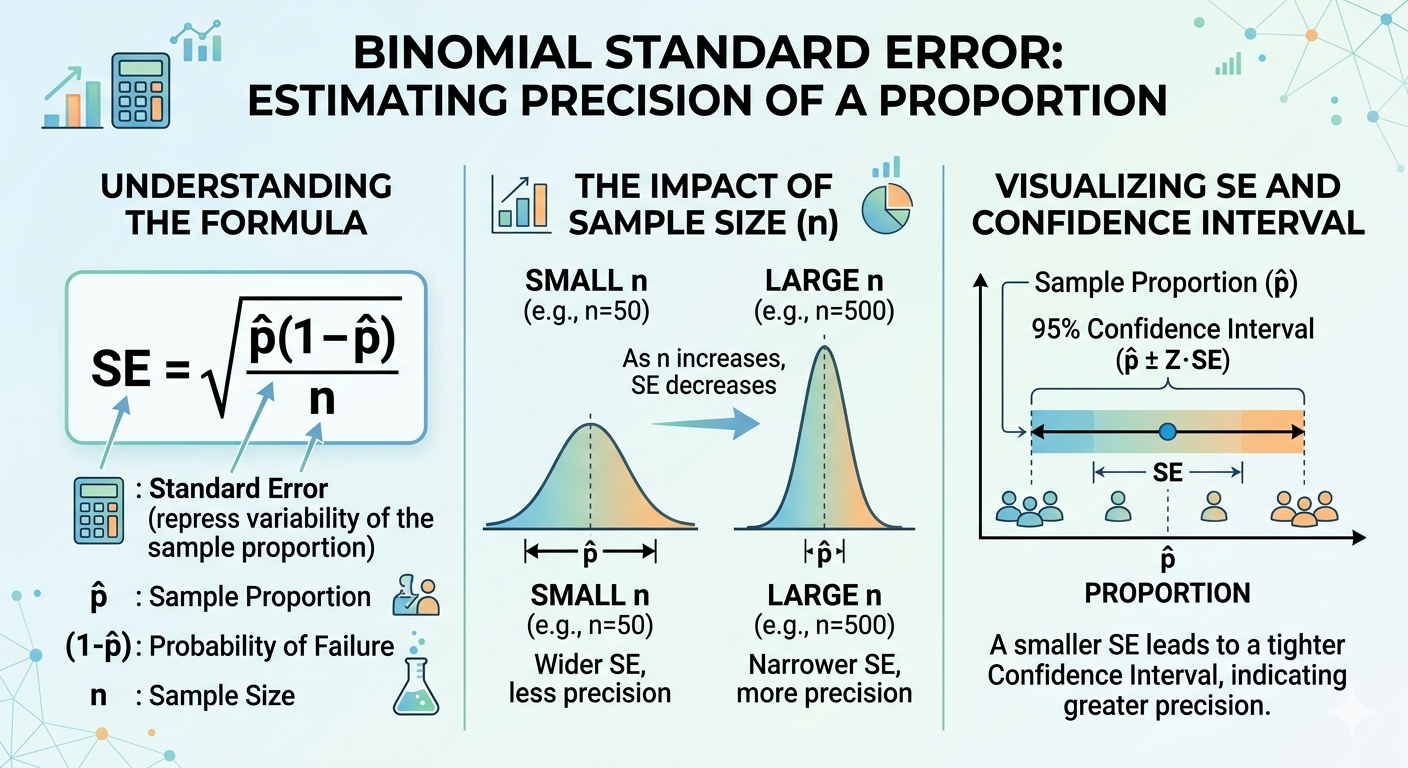
Standard Error in Binomial Distribution
A coin is tossed 1000 times and it landed heads 400 times. How confident we are whether the coin is fair ?
We can do a test of proportions, and our test statistic is (\(\bar{p}\)-\({P}\))/\(\sqrt{PQ/n}\)
The sample size (n) is 1000 and we have observed heads 400 times meaning \(\bar{p}\) = 0.4 and \(\bar{q}\) = 0.6.
The sample mean \(\bar{x}\) is 400 (1000 x 0.4) (X is binomial)
here P = Q = 0.5 (population estimate)
Now the denominator \(\sqrt{PQ/n}\) is the standard error of the sample proportion \(\bar{p}\)
This variance scaling is not really intuitive at the first look.
The variance is scaled by square of n, so the variance of sample proportion is \({nPQ/n^2}\) which is PQ/n and hence the standard error (same as standard deviation) is \(\sqrt{PQ/n}\)
We could have solved the problem by testing number of heads instead of proportion of heads (400-500/15.81). 15.81 is just simply \(\sqrt{0.5*.0.5*1000}\)